Foreword
During my curatorial residency at Kunstmuseum Bochum (KMB), researching Fluxus and its contributions, I examined how public and non-market spaces were key sites for realizing their ambition of “art as life, life as art.
I have tried to develop here some thoughts that emerged over these past eight months. I find a contemporary relevance in investing in these fifty-to-sixty-year-old topics, considering the current French and German art scene in relation to their economic and political context.
This text references the two-part exhibition HOW WE MET / HOW WE MEET, unfolding across 2025 and 2026 at Kunstmuseum Bochum, for which I was part of the curatorial team alongside Shasti (Andara Shastika), Eva Busch and Julia Lerch Zajączkowska.
Introduction
Public art — meaning the presentation of objects labeled as such — displayed outside the built infrastructures of the institution, can be found in urban areas through static and “utilitarian” forms of “embellishment”: in parks, as murals on highways, or as roundabout sculptures. The latter being a French specialty in the embezzlement of public funds.
European public space today is mainly owned by private or state-related structures, and its contractualization increases in areas affected by gentrification. For example several European cities have put considerable effort into legal convolution and hostile architecture, banning homeless people from public space over the last ten years.
Because interventions outside walls require extensive administrative paperwork, cultural actors and art institutions can be quite reluctant to invest in outdoor work, apart from public art commissions. This, combined with the petitory character of artwork in the West, makes makers and buyers far more inclined toward objects that can be presented and stored inside walls. We thus find ourselves drowning in the products of artistic practice. Like any other capitalist market, artists are expected to churn out shiny props that entertain and excite the acquisitive drives of their clients.
Proposals that invest in more temporary forms are relegated to specifically labeled branches — “performance” or “living” art — turning static objects “dead” by contrast. Except within dedicated structures that still encapsulate these fluid formats inside walls (theatres, concert halls, open stages, etc.), performance, sound, and happenings are still largely confined to the role of entertainment punctuation within the close perimeter of the exhibition space (hall, courtyard, foyer, terraces, etc.).
Before
In western spaces, most site-specific interventions engaging in institutional or social critique through ephemeral and/or intangible forms take root in the specific context of the contemporary art market’s exponential development through post-WWII economic liberalisation and globalisation.
First-generation Gutai and Hi-Red Center in Japan, and early Fluxus in New York and Germany, are examples of how pioneering outdoor manifestations invested in the possibility for art to exist within people’s living spaces, rather than through speculative commodified objects. Open-air festivals and Happenings were pathways toward a distinctive approach to art.
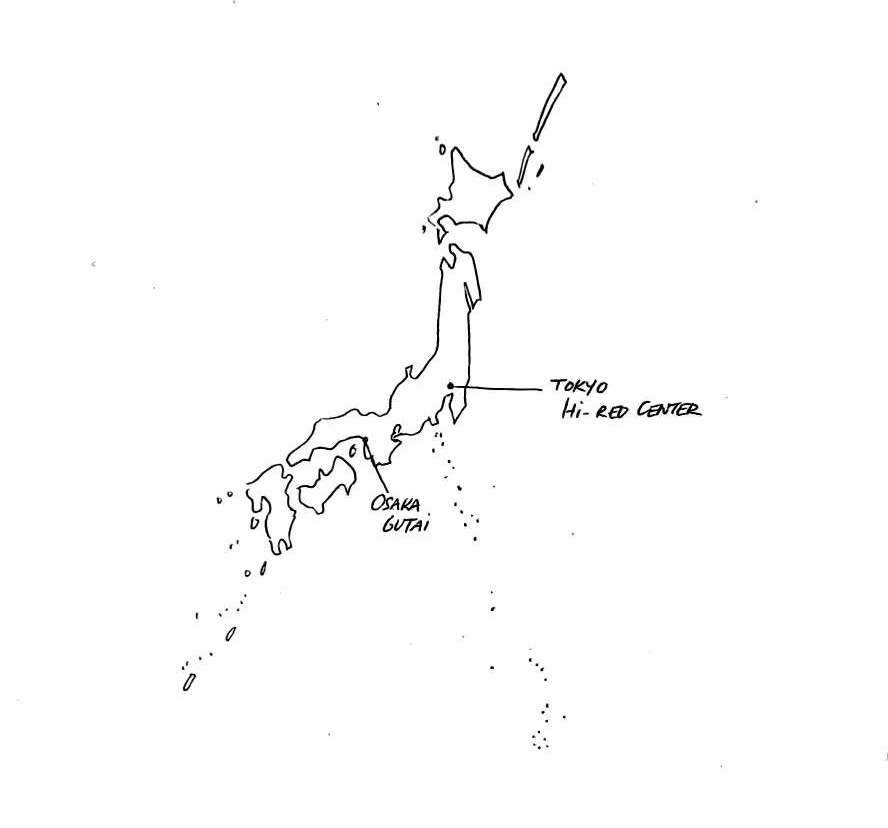
Gutai (“concreteness” in Japanese) was founded by Yoshihara Jirō (1905–1972) in 1954, around a core group of twenty artists based mainly in Osaka, Kansai, two years after the end of the United States occupation, under an authoritarian postwar regime. The group went through different periods (Early, Middle, and Late), structured around several shifts in their practices, approaches, and statements, from 1954 to 1972.
In the summer of 1955, on the riverbank of the Ashiya River, Gutai organised their first outdoor exhibition. The event was inspired by the group’s previous participation in a show commissioned by the Ashiya City Art Association at the same location the year before, and was rooted in the Japanese tradition of popular seasonal festivals and outdoor parades.
Over the course of nearly two weeks, the group held a show that invited visitors to interact not only with the artworks but also with the environment surrounding them. Without walls or roof, they attached and anchored works to the pine trees and into the soil. At the close of the “Experimental Outdoor Exhibition of Modern Art to Challenge the Mid-Summer Sun,” they lit a bonfire and burned their works (they had nowhere to store them lol).
Another of their early outdoor events was held on the roof of the Takashimaya Department Store in Osaka. In 1960, Gutai sent invitations to numerous international artists to take part in the International Sky Festival. As a cost-efficient solution, artists submitted their sketches by post; these were then enlarged and transferred onto fabric banners, which were attached to helium balloons and left to flutter in the wind — like messages in bottles sent into the sky, or koinobori.
Though sovereignty over national airspace exists, and private and state-owned companies have colonised space since the Cold War, the sky remains the place most difficult to own — indefinite and shared by all.
That same year, beyond the openness and vibrant spirit of artistic experimentation of the Festival, the Anpo struggle brought together an estimated 30 million people — roughly one third of the Japanese population at the time — across a series of demonstrations throughout the country. These protests against a treaty permitting the United States to maintain its military bases in Japan are considered the largest postwar social movement in the country’s history. Though the protests were swept away by violent repression, the question remains alive in Parliament today, as the USA stations approximately 55,000 active troops across more than 120 military installations in Japan, making it the country hosting the largest number of foreign US bases.
Nonetheless, while Gutai may have been “intentionally disinterested in the formalist arguments of modern Euro-American abstract art and averse to the use of art as political activism”(1) its commitment to action as statement demanded collective engagement and interrogated the status of art in society. In learning about Gutai, I find myself wondering whether action might be art’s most effective form — in its capacity to confer agency, of mind and of gesture, not only upon its maker but also upon whoever receives it.
Another Japanese artist group from the early 1960s is also relevant regarding practices investing the outdoors and spaces not officially related to art. Centred around founders Genpei Akasegawa, Natsuyuki Nakanishi, and Jirō Takamatsu, Hi-Red Center was active from May 1963 to 1964. In contrast to Gutai, they promoted an anti-establishment spirit and social awareness. Rooted in Tokyo, they used their urban environment as a backdrop for happenings and actions questioning structures of dominance and control.
For instance, in 1964, the group designed personalised nuclear fallout shelters during “The Shelter Plan” (Shieruta puran) event, which took place at the Teikoku Hotel in Tokyo — barely twenty years after the bombing of Hiroshima and Nagasaki by the United States.
Though I could only access limited digitised documentation of the group’s actions, a map edited in 1965 by Shigeko Kubota and published by George Maciunas’ publishing house attests to the connection and mutual interest between Hi-Red Center and Fluxus. The map lists 21 locations — some linked to multiple actions — all within a span of barely twelve months.
Overall, Hi-Red Center held a radical position that led them at times to commit illegal acts, such as producing and distributing counterfeit bills during events (2). Though some of their actions took place in crowded settings such as subway carriages, they would mostly perform without an audience, documenting their actions through photography. Both Gutai and Hi-Red Center shared a simple (humble?) range of materials, that may have been partly inspired by their financial situation as well as by the ephemeral nature of their works.
On the Atlantic coast, starting from its 4th edition (1966), the annual Avant-Garde Festival of New York shifted its focus toward bringing the largest possible number of New Yorkers onboard — literally — with experimental music, performance, and early contemporary art. Presented within the exhibition HOW WE MET at Kunstmuseum Bochum (11.25–02.26), some of the posters announcing the artist lists for the various editions of the fifteen-year-long festival speak to Charlotte Moorman’s obsession with gathering people and giving space to anyone willing to engage in the project. The amateur film projected alongside these documents, which shows the 5th Annual Avant-Garde Festival (29–30 September 1967) on the ferry around Ellis Island, shows the faces of audiences of various ages, origins, genders, and class backgrounds observing the Dada-esque chaos unfolding before them — to their pleasure, excitement, and surprise.
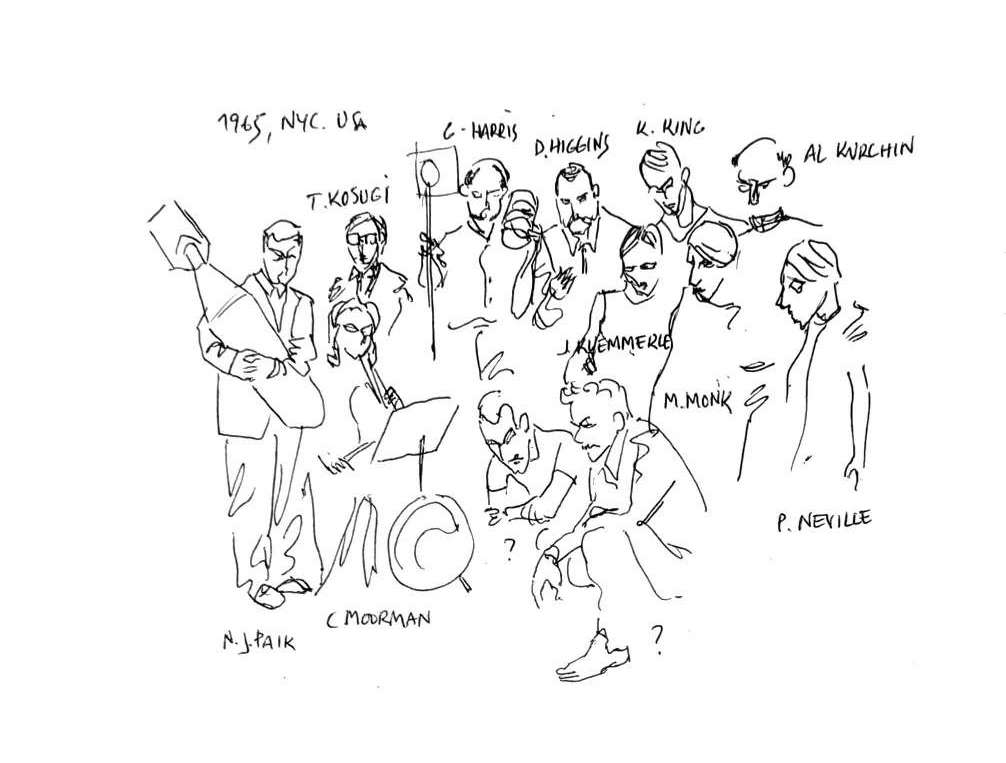
The Festival’s director and curator Charlotte Moorman was transparent about the administrative hardships she faced in order to hold the event; engaging with urban public space was already a challenge. As Jud Yalkut puts it in his article “Evolution of the New York Avant-Garde Festival”:
“Certainly as the festival moved around in search of ever-changing quarters, the requirements of a bureaucratic administration were constantly accentuated, and yet each year the Festival managed to wage its demonstration of the indomitability of the contemporary artist.”
The struggle is echoed in another press article by Peter Frank (“The Avant-Garde Festivals: And Now, Shea Stadium,” Art in America), about the 1973 edition: “The festival is a tribute to the organizational capabilities of the indomitable Moorman. […] Even during the festival she continually had to prevent petty bureaucratic foolishness from thwarting some of the artists’ projects. The technical side of each festival is, inevitably, a potential nightmare. With so much to go wrong, much does. […] Nevertheless, Moorman and festival chairman Frank Pileggi somehow manage to structure every festival so that the hundreds of works presented actually work.”
Another example from the various Fluxus happenings in the city is that of the “tailor” of the term. Allan Kaprow (1927–2006) staged a great number of actions through the streets of New York, sometimes with public participation, making this a very early form of relational aesthetics. Some of his scores were carried out alone, photographed by simply using a cable release. Like Hi-Red Center in Tokyo, Kaprow’s attention to documentation attests to his awareness of the temporary and silent character of his work — one could argue that these photographs were more about keeping a trace than producing a saleable object from his actions, though they were quickly absorbed by the market as auctionable works.
Not shown in the KMB exhibition but a significant part of the conceptual development of this text, stanley brouwn (1935–2017) is a figure who mastered the exploration of questions surrounding the artist’s embeddedness in authorship and physicality, and the relationship of art with its audiences, establishing a conceptual body of work rooted in people and places.
Born in Suriname in 1935 under the colonial rule of the Dutch crown, he emigrated to the Netherlands in 1957, three years after independence. He settled in Amsterdam and gravitated outward from there, with appearances in Germany, Belgium, and France. Quickly affiliated with the Dutch Nul group — “an offshoot of the German Zero group that sought new relationships between art and reality” — he also drew close to Fluxus, as evidenced by the card designed by Maciunas in his name, as he did for every artists he welcomed into the community. He was, and remains, a precious, enigmatic, and sporadic presence. A few photographs by Igno Cuypers show the man in action, during his performance THIS WAY BROUWN (1960–1964), which relied on the collaboration of anonymous passers-by, unaware of their participation in the making of the artwork.
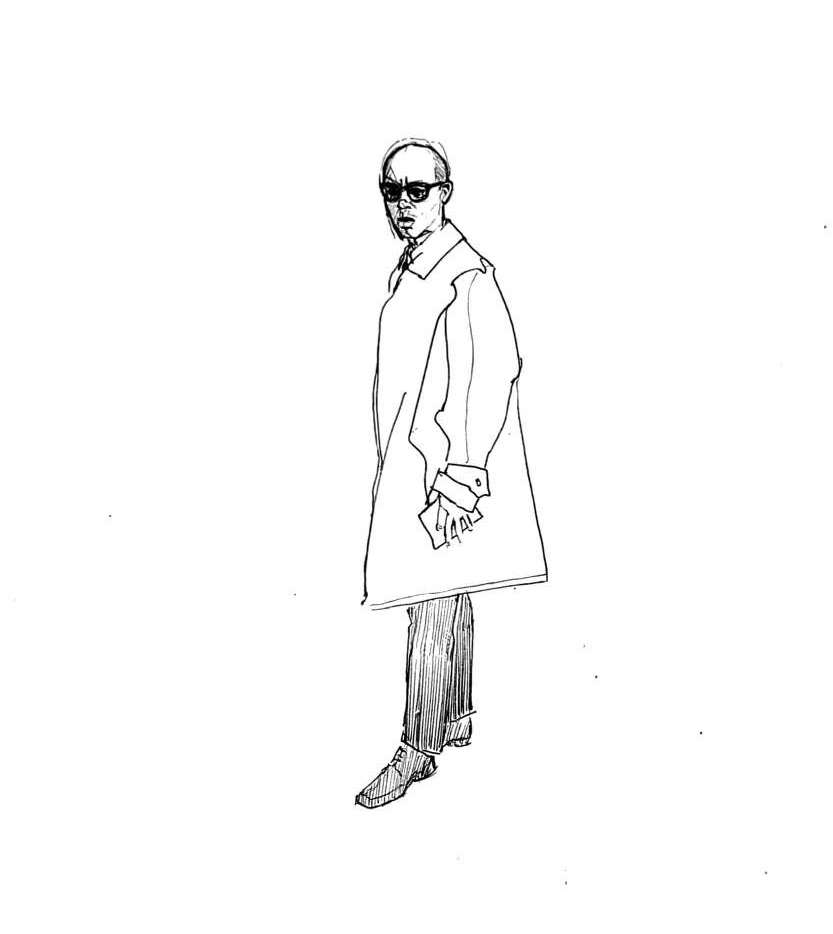
He haunted the galleries, debates, and press of his time as a discreet — if not absent — yet deeply impactful figure. He never attended his own openings, never gave an interview, though he taught at Ateliers 63 in Haarlem (now De Ateliers, Amsterdam) from the 1970s to the early 1980s, represented the Netherlands at Venice in 1982, and participated in Documenta four times.
Now
Ten to twenty years on, the idea of existing as an artist solely outside the market and institution has become a chimera — achieved only as a posthumous retrospective of unknown artists, by the very spaces that had excluded or ignored them. Following the exponential curve of the capitalist economy, the art market never ceased growing, though it suffered episodic crises. Sorry, Fluxus — it was only just a dream.
Some artists persisted in inhabiting the interstices between inside and outside, seeking the potential of an in-between position. Andrea Fraser’s practice navigates contemporary art through what she has called project-based practice since the 1980s. She continues to offer context-specific propositions that are often ephemeral and rely on the participation of particular audiences. Within The Services Working Group (3), the question of address remains: why is the contemporary art field so obsessed with its audience, yet seemingly unable to grasp that people should not be considered merely as minds to captivate and steer into a preconceived discourse or project? Or, as Mike Kelley wrote, is it that “public art is always doomed to failure because of its basic passive/aggressive nature” (5)?
Fluxus failed to foster a long-term movement rooted in people and in the street — an art form that would privilege spontaneous and absurd happenings over staged and scripted performances. It is now remembered as a brilliant burst of energy from 1960s eccentrics, immigrants, and New Yorkers, travelling across Europe.
Post-Brexit, post-COVID, and in a climate of sustained anxiety around the unfamiliar, the spaces where art unfolds seem condemned to settled or gentrified areas and clearly defined identities, scared to go out of sight, out at all.
One could argue that the map is overcrowded and that empty spaces are scarce within the urban field. But what prevents us from exploring new spatial perspectives in rural or remote areas? Surely it is the proximity to the centre that provides the reassuring presence of bankable labels — institutions and market-affiliated locations.
This fear of connection across distance says a great deal about artists’ (and curators’ ofc) dependency on visibility and performed consistency.
This is one of the challenges faced by Kunstmuseum Bochum — an institution funded by city and state, yet citizens struggle to identify it as a space that belongs to them. This disconnection is something the team works on continuously, seeking to shape the institution into a place that genuinely serves its neighbours: proposing quality content in meaningful relation to local context.
Though it is a building, not an open ground, the architecture of KMB was designed to accommodate music, dance, performance, and all forms of “living art” (by Jørgen Bo & Vilhelm Wohlert). The high ceilings, acoustics, open rooms, and music hall are tangible invitations for bodies to inhabit the space. In an attempt to hold in tension the reality of a museum exhibition within an institution and Fluxus’s desire for art outside of one, HOW WE MET places the ground-floor room at the public’s disposal, offering a range of scores by various Fluxus artists to be performed freely. Touching, making, running, and shouting are all welcome — in the hope that this empowerment might lead, over time, to a genuine mental re-appropriation of KMB’s space by its visitors.
In the second part of the project, two Japanese contemporary artists — Ei Arakawa-Nash and Yuko Mohri — are invited to propose works in resonance with Fluxus works from the collection, and in relation to the considerable influence of Japanese figures such as Takahiko Iimura, Yoko Ono, Shiomi Mieko, and Takako Saito.
Meanwhile
The growing importance of temporary, discourse-focused formats — working groups, workshops, consortia, shared meals — has not fundamentally altered the institutional logic they operate within. More often than not, they become reabsorbed into a demonstrative entertainment function: markers punctuating the temporality of an exhibition, or satisfying an institution’s educational ambitions while remaining, structurally, on its own terms — separated from public space and daily life.
Public space offers different ground for artists. Potentially detached from specific agendas, control mechanisms, or obligations of return, it remains an inexpensive site of encounter and expression. The urgency with which contemporary policy seeks to occupy, regulate, and police these spaces — and the actions that unfold within them — reveals something significant about how states and governing bodies conceive of their populations: with distrust toward the general public’s capacity to self-organize, and with an impulse to control bodies and movement, exercised by a ruling class both frightened by and estranged from those it governs.
It is worth noting, however, that the overall profile of art practitioners has never been one of the margins — and remains so (even if you want to keep believing the opposite). What is perhaps more surprising is that so few art workers seem driven by a particular investment in the “outside” as a terrain: a space that allows for direct challenge to authority. A part of contemporary artistic practice does engage with communities beyond artistic circles, supporting processes of empowerment, agency, and a renegotiation of the relationships between bodies and space. But this remains a fraction of the field. Because it means encouraging open interpretation and critique, abandoning authorship as ownership, addressing political issues, and agreeing to “feel the discomfort of irresolution and allow it to become a condition while your response evolves” (5).
Meanwhile, a large number of artists and curators remain preoccupied with the permanence of their work’s material outcomes. Their capacity to persist through time is secured by the apparatus of Western conservation standards — hygrometry, temperature, light exposure — and the institutions that maintain them. This raises a question I keep returning to: where does transmission end and egotistic posterity begin in art? If not the artist’s legacy, then the institution’s — taking on the presumed responsibility to fight time, preserve the work, and present it (according to its own protocol).
omg this monologue is too long, let’s conclude and open on this:
Freedom of expression and assembly is often invoked only in its civil and political dimensions, forgetting its equally important cultural dimension. On this matter, a summary of a 2019 United Nations General Assembly report on “Promotion and Protection of Human Rights: Human Rights Questions, Including Alternative Approaches for Improving the Effective Enjoyment of Human Rights and Fundamental Freedoms” stated:
“The report addresses the importance of public spaces for the exercise of cultural rights and the challenges which must be addressed so that everyone can access and enjoy such spaces. It reviews existing frameworks and proposes a more holistic human rights-based approach for policymaking. The nature, form and size of the space may vary. As mentioned above, public spaces include not only urban but also rural and natural spaces (including squares, parks, cemeteries, public transportation, forests, mountains and waterfronts), real and virtual spaces, cultural sites, public facilities (including public housing, libraries and museums, public schools and town halls) and streets.”
As I see the once-coveted city-centre spaces now emptied and abandoned by real estate speculation and online marketplaces, I find myself wondering: what reconfigurations of our environment might still be possible, and what places could art and artists occupy in order to truly meet life? I look forward to finding out.
Illustrations: Adèle Anstett
- Alexandra Munroe, “To Challenge the Midsummer Sun: The Gutai Group,” in Japanese Art After 1945: Scream Against the Sky, ed. Alexandra Munroe (New York: Harry N. Abrams, 1994).
- “(1)A person who counterfeits or alters a current coin, bank note or bill for the purpose of uttering is punished by imprisonment for life or for a definite term of not less than 3 years.(2) The same applies to a person who utters, or delivers or imports for the purpose of uttering, a counterfeited or altered coin, bank note or bill..”Penal Code, Part II, Chapter XVI, Article 148, adopted April 24, 1907 (Japan).
- Helmut Draxler and Andrea Fraser, eds., The Services Working Group, Folio F (Vancouver: Fillip Editions, 2021). “(…) complete transcripts from the ground-breaking working group on labour relations and institutional governance in the arts organized in 1994 by Helmut Draxler and Andrea Fraser at the Kunstraum of the University of Lüneburg.”
- Mike Kelley, “Mobile Homestead,” in Whitney Biennial 2012, eds. Jay Sanders and Elisabeth Sussman (New York: Whitney Museum of American Art, 2012), 158–161.
- Mary Jane Jacob, Michael Brenson, and Eva M. Olson, Culture in Action: A Public Art Program of Sculpture Chicago, 1995.